Published 2026-07-14Updated 2026-07-1410 min read
The previous chapters established an uncomfortable fact: the processes that decide a building's future — the carbonation front advancing through the cover, chlorides accumulating at the bars, corrosion consuming steel section — are all invisible from the surface. An audit that only looks can only find what has already broken through. Testing is how an audit sees ahead.
Definition — Non-destructive testing (NDT)
Non-destructive testing is a family of test methods that assess the condition of concrete and reinforcement — strength, uniformity, chemistry and corrosion activity — without damaging the structure being tested.
Each test answers one specific question. None answers every question. Reading them together — and against the visual survey — is the interpretive work at the heart of a structural audit.
| Test | The question it answers |
|---|---|
| Ultrasonic pulse velocity (UPV) | How sound and uniform is the concrete inside this member? |
| Rebound hammer | How hard is the concrete surface, and how consistent is it across members? |
| Carbonation depth | How far has the carbonation front advanced toward the steel? |
| Cover meter | Where are the bars, and how much protective cover do they actually have? |
| Half-cell potential | Is corrosion actively occurring, and where? |
| Core testing (minor drilling) | What is the concrete's actual strength and condition, confirmed physically? |
Ultrasonic pulse velocity: listening through concrete
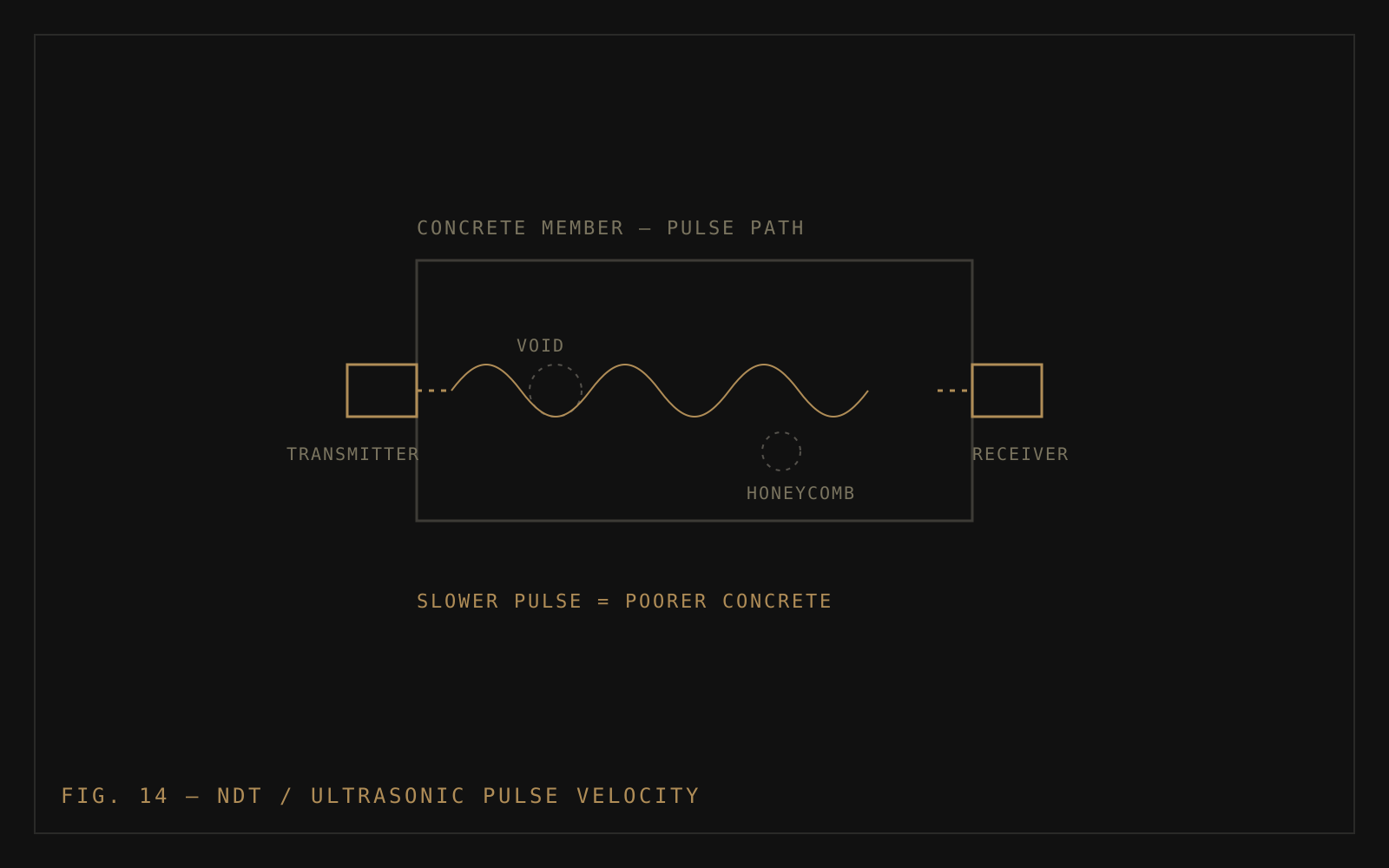
UPV sends an ultrasonic pulse from a transmitter on one face of a member to a receiver on another, and measures how long it takes. Sound travels fast through dense, continuous concrete and slows through cracks, voids and honeycombing — so the velocity is a direct index of internal quality. Mapping velocities across a member reveals hidden defects; comparing members ranks their condition objectively.
Rebound hammer: the quick surface check
The rebound hammer presses a spring-loaded plunger against the concrete and measures how strongly it bounces back — harder surfaces rebound more. It is fast, cheap and covers many members quickly, which makes it excellent for comparative screening. Its honest limitation: it reads only the surface, and surface hardness is influenced by carbonation, moisture and finish. Engineers use it to find outliers and patterns, not as a strength certificate — and codes pair it with UPV for exactly that reason.
Carbonation depth: the pink test
Spray phenolphthalein indicator on a freshly exposed concrete surface and the chemistry from the water chapter becomes visible: healthy alkaline concrete turns pink, carbonated concrete stays colourless. Measured against the cover depth from a cover meter survey, this single elegant test answers the question that most determines a building's remaining durability: how much protective margin is left between the carbonation front and the steel?
Half-cell potential: mapping active corrosion
Corrosion is an electrochemical process, and active corrosion sites create measurable electrical potentials. The half-cell survey moves a reference electrode across the surface, mapping those potentials over the member. The result is a corrosion map — which bars are likely corroding and where — produced before anything is broken open. It guides exactly where repairs must reach, and where they need not.
Reading tests together
One example shows why interpretation matters more than any instrument. A column shows moderate rebound values: alone, ambiguous. Add low UPV in the same zone: internal voids likely. Add carbonation reaching bar depth and strongly negative half-cell potentials: active corrosion in weak, unprotected concrete. Four modest readings, one clear engineering conclusion — and a repair specification that addresses cause, extent and urgency. That synthesis is what a structural audit is for.
Tests are selected to answer questions raised by the visual survey — not applied as a package to every building. Testing everything indiscriminately adds cost without adding engineering value.