Published 2026-07-14Updated 2026-07-1410 min read
Ask why a thirty-year-old building needs structural repairs and the honest one-word answer is usually: water. Not floods or leaks alone — ordinary rain, ordinary humidity, ordinary air, working on ordinary concrete for decades. Water is both a weapon and a courier: it attacks some materials directly, and it carries the two agents that do the deepest damage to reinforced concrete — carbon dioxide and chlorides — to where the steel lives.
To understand either attack, start with what protects the steel in the first place. Fresh concrete is intensely alkaline — around pH 13. At that alkalinity, steel spontaneously forms a microscopically thin oxide skin called the passive layer, which stops rust completely. Reinforcement inside sound concrete is not protected because it is dry; it is protected because it is chemically passivated. Both carbonation and chloride attack are, at bottom, ways of destroying that passivation.
Carbonation: the slow loss of protection
Definition — Carbonation
Carbonation is a chemical process in which atmospheric carbon dioxide dissolves in the moisture inside concrete pores and reacts with the concrete's alkaline compounds, converting them to carbonates and lowering the pH from around 13 to around 9 — below the level at which steel's protective passive layer can survive.
Carbonation begins at the surface on the day the concrete is cast and advances inward as a front — millimetre by millimetre, decade by decade. In dense, well-cured concrete the front moves slowly and may need many decades to travel a typical cover depth. In porous, poorly compacted or cracked concrete it can move several times faster. The concrete loses nothing visible in the process: carbonated concrete is just as hard. What it loses is chemistry.
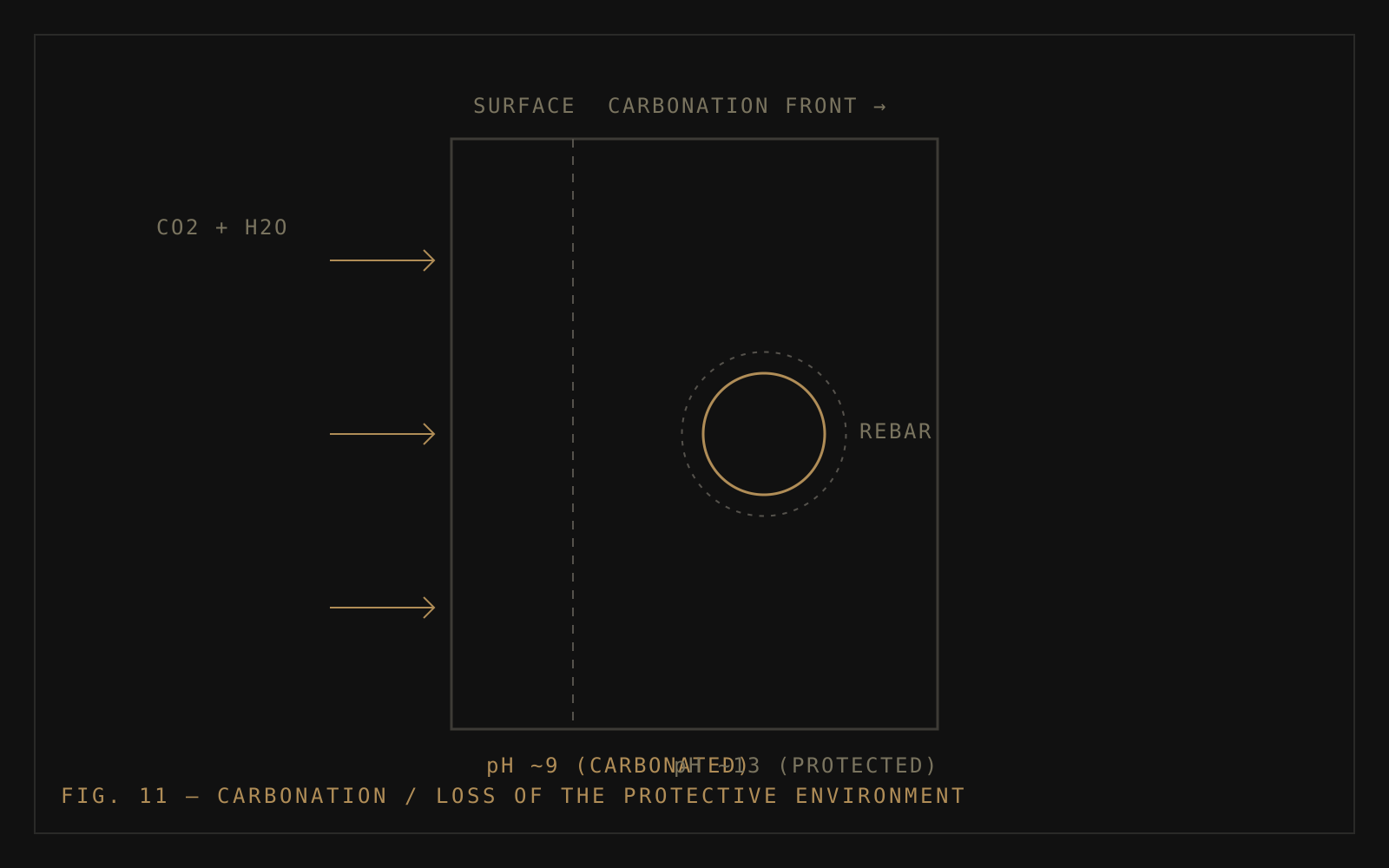
Nothing dramatic happens until the front reaches the steel. Then the passive layer dissolves, and the bar is simply ordinary steel sitting in a damp, oxygen-fed environment — and ordinary steel rusts. Everything visible that follows — cracking along the bar lines, spalling cover, exposed reinforcement — is the late, public stage of a process that spent twenty years working in private.
Chloride attack: the coastal accelerant
Definition — Chloride attack
Chloride attack is the corrosion of reinforcement caused by chloride ions — from sea air, saline groundwater or contaminated construction materials — penetrating the concrete and breaking down the steel's passive layer locally, even while the concrete around it remains fully alkaline.
For a coastal city like Mumbai this is not a footnote; it is the environment. Sea air carries chloride-laden moisture that deposits on façades year after year, and every monsoon drives it deeper. Chlorides are more dangerous than carbonation for two reasons. First, they do not need to neutralise the concrete — they punch through passivation locally at full alkalinity. Second, the corrosion they cause is pitting: intensely localised attack that can eat deep notches into a bar, cutting its cross-section far faster than uniform rust, with less visible warning on the surface.
The expansion cycle: why corrosion cracks concrete
Rust is bulkier than the steel it came from — several times its volume. As corrosion products form around a bar, they press outward on the surrounding concrete like a slowly inflating jack. Concrete, weak in tension, splits: first a crack tracing the line of the bar, then delamination of the cover, then a spall dropping away to expose the bar entirely. Exposure brings more moisture and oxygen, corrosion accelerates, and the cycle feeds itself. This is why corrosion damage seems to appear suddenly and spread quickly — the visible stage is the fast stage.
The order matters: by the time cracking appears along a reinforcement line, corrosion is established, not beginning. Painting over the crack treats the last step of the process and none of the previous ones.
Signs your building may be under attack
- Fine cracks tracing straight lines — following the reinforcement beneath
- Rust stains bleeding through plaster or concrete surfaces
- Bulging, hollow-sounding or delaminating plaster and cover
- Spalled patches with reinforcement visible, often already pitted
- Persistent damp patches or leakage — the water supply for every mechanism above
How engineers actually detect it
Because both attacks are invisible until late, detection is a testing exercise, not a viewing one. A structural audit deploys tests that read the chemistry directly.
| Test | What it reveals |
|---|---|
| Carbonation depth (phenolphthalein) | How far the carbonation front has advanced — the indicator stays colourless on carbonated concrete and turns pink where alkalinity survives |
| Cover meter survey | The actual depth of concrete over the bars — compared with carbonation depth, it answers how much protection remains |
| Chloride content analysis | Whether chloride concentration at bar depth has crossed corrosion thresholds |
| Half-cell potential mapping | Where active corrosion is occurring, mapped across a member before anything is broken open |
| Thermography | Hidden moisture and leakage paths feeding the attack — surveyed across the whole envelope |
What protects a building
Prevention is unglamorous and overwhelmingly cost-effective. Adequate concrete cover keeps both attack fronts far from the steel — the subject of the next article. Intact waterproofing and external finishes deny water its entry. Prompt attention to leakage removes the courier. And periodic structural audits catch the chemistry moving while the response is still minor repair rather than major rehabilitation. Buildings rarely fail from unknown causes; they fail from known causes given enough undisturbed time.