Service
Tender Consultancy
Contractor selection decides the outcome of a repair project before work begins. We prepare technically sound tender documents and run transparent, predefined evaluation methodologies — so societies select contractors on evidence, not persuasion.
Definition
What is tender consultancy?
Tender consultancy is the preparation and management of the contractor selection process for a repair project: the bill of quantities, technical specifications and tender conditions that define the work, the prequalification that defines who may bid, and the evaluation methodology that defines how a winner is selected.
The essential principle is that the rules are fixed before the game is played. When the evaluation methodology is defined and disclosed before bids are opened, no result can be steered afterwards — every bidder is measured against the same published criteria, and the outcome can be defended to every member of the society.
Purpose
Why is it required?
The gap between a good and a poor contractor is the largest single variable in any repair project — larger than any difference in materials or supervision. Yet contractor selection in housing societies is routinely done by comparing incomparable quotations from an informally assembled list.
When bids are not priced against identical measured quantities and specifications, the lowest number usually belongs to the bidder who has understood the scope least — or excluded the most. The 'saving' returns as variations, disputes and compromised quality.
Committees also carry a fiduciary burden: they must be able to demonstrate to members why a particular contractor was selected. A predefined, mathematical evaluation converts that explanation from a matter of trust into a matter of record.
Traditional Practice
How the industry usually does it — and where that falls short.
The common practice is to collect three or four quotations against a brief scope description, compare the totals, and negotiate with the lowest bidder.
- Each bidder interprets — and prices — a different scope, so the totals are not comparable
- Capability, track record and financial standing are assessed informally, if at all
- Selection criteria are decided (or bent) after prices are known
- Paper submissions offer no protection against late changes or selective disclosure
- The committee cannot objectively defend the decision to society members
Our Methodology
How we do it.
01
Measured bill of quantities
The BOQ is built from measured quantities — from the digital twin and audit where available — so every bidder prices identical, verifiable scope. This single step eliminates the largest source of tender distortion.
02
Technical specifications and conditions
Materials, methods, quality standards and contract conditions are specified in detail. A specification that leaves method to the contractor's discretion becomes a dispute during execution.
03
Vendor prequalification
Bidders are qualified against defined criteria — relevant experience, technical capability, financial standing and site organisation — before commercial bids are considered. Prequalification is about who is capable of the work, independent of price.
04
Evaluation methodology fixed in advance
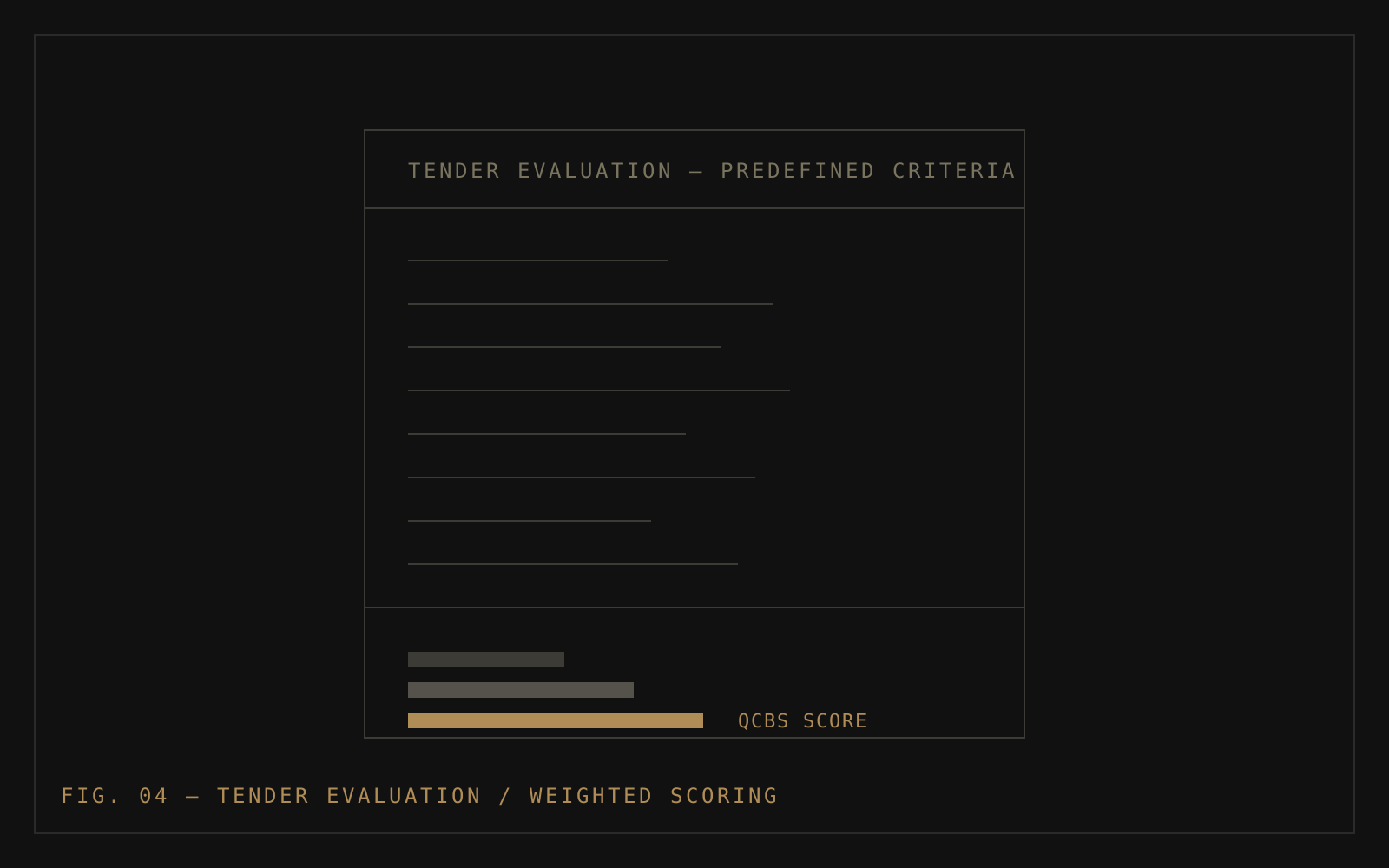
The evaluation method — L1, QCBS, MEAT or a custom weighted model — with its criteria and weightages is defined and disclosed in the tender document itself, before any bid is submitted. L1 selects the lowest qualified price; QCBS scores quality and cost with predefined weightages; MEAT selects the most economically advantageous tender across price, quality, timeline and lifecycle factors.
05
Digital tender execution
Bids are submitted through our digital tender platform — encrypted until the published opening time, time-stamped, and evaluated with mathematical scoring applied identically to every bidder. Paperless workflows leave a complete audit trail.
06
Recommendation report
The committee receives a documented evaluation: every bidder's scores against every published criterion, and a recommendation the committee can table before its members with full transparency.
Technology Used
The tools behind the methodology.
- Digital Tender PlatformEncrypted submission, mathematical scoring
- Digital TwinMeasured quantities behind the BOQ
From the Knowledge Centre
Deliverables
What you receive.
- Bill of quantities from measured data
- Technical specifications and tender conditions
- Prequalification criteria and vendor assessment
- Published evaluation methodology
- Digitally managed bid process with audit trail
- Technical and financial evaluation reports
- Tender recommendation report for the committee
Benefits
Why it matters.
Comparable bids
Identical measured quantities and specifications mean the differences between bids reflect the bidders — not their interpretations of the scope.
Defensible decisions
Every score traces to a criterion published before bids were opened. The committee's recommendation is a document, not an assurance.
The right contractor, not just the cheapest
Quality-weighted methods select the most suitable contractor for the project — the stated objective of our tender philosophy.
Bid integrity by design
Encrypted digital submission and time-stamped openings remove the vulnerabilities of paper tenders — nothing can be added, altered or selectively disclosed.
Typical Applications
Where this service is used.
- Housing society repair tenders
- Structural rehabilitation contracts
- Waterproofing and façade repair packages
- High-value repair projects needing QCBS/MEAT
- Committees requiring documented transparency
Frequently Asked Questions
Questions clients actually ask.
What is QCBS?
Quality and Cost Based Selection is an evaluation method in which bids receive a technical score and a financial score, combined using weightages published in the tender — for example 70:30. It prevents a marginal price advantage from outweighing a significant quality difference, and is widely used in government procurement.
What is MEAT?
Most Economically Advantageous Tender is an evaluation approach that selects the best overall value across multiple predefined criteria — price, quality, timeline, methodology and lifecycle cost — rather than the lowest headline price. The criteria and their weightages are fixed before bids are invited.
Why not simply choose the lowest bidder?
L1 selection is appropriate when scope is precisely defined and all qualified bidders would deliver equivalent quality. In repair work, where execution quality varies enormously, the lowest price frequently belongs to the bidder who has understood or included the least — and the difference returns as variations and defects. Quality-weighted methods exist to price that risk into the selection.
How is fairness actually ensured?
Mechanically, not rhetorically: identical measured quantities for every bidder, evaluation criteria and weightages published before bids are opened, encrypted submissions opened at a fixed time, mathematical scoring applied identically to all, and a documented evaluation trail the committee can share with members.
What is digital tendering?
A paperless tender process run on a secure platform: bidders submit encrypted bids online, submissions are time-stamped and sealed until the published opening, scoring is computed mathematically, and every step is logged. It removes both the logistics and the vulnerabilities of paper tenders.
Can society members see how the evaluation was done?
Yes — that is the point. The evaluation methodology is part of the tender document, and the recommendation report shows each bidder's scores against each published criterion. The committee can place the entire selection rationale before its members.
Related Services
The rest of the repair lifecycle.
- Structural AuditA systematic engineering assessment of an existing building undertaken to evaluate its structural condition, identify deterioration mechanisms and recommend appropriate repair measures.
- Digital TwinA measurable digital representation of an existing building, created from drone imagery using photogrammetry.
- Full Building ThermographyAn infrared imaging survey of the complete building envelope, used to identify conditions that are not visible during conventional visual inspection.
- Project Management ConsultancyEngineering oversight of repair execution — quality, cost, time, safety, documentation and financial transparency — from commencement until completion.
Next Step
Discuss your building with our engineers.
Whether your society is planning a structural audit, preparing a tender or beginning a repair project, the right first step is an engineering conversation — not a sales call.