Published 2026-07-17Updated 2026-07-179 min read
Concrete is unusual among structural materials in that it is manufactured on site, in the weather, by hand, in a race against its own setting time. Steel arrives from a mill with certified properties; concrete's properties are decided in the hours it is mixed, placed, compacted and cured. Done well, the result is the dense, alkaline mass that protects steel for decades. Done poorly, the defects are sealed inside — invisible on handover day, patient for twenty years.
Definition — Honeycombing
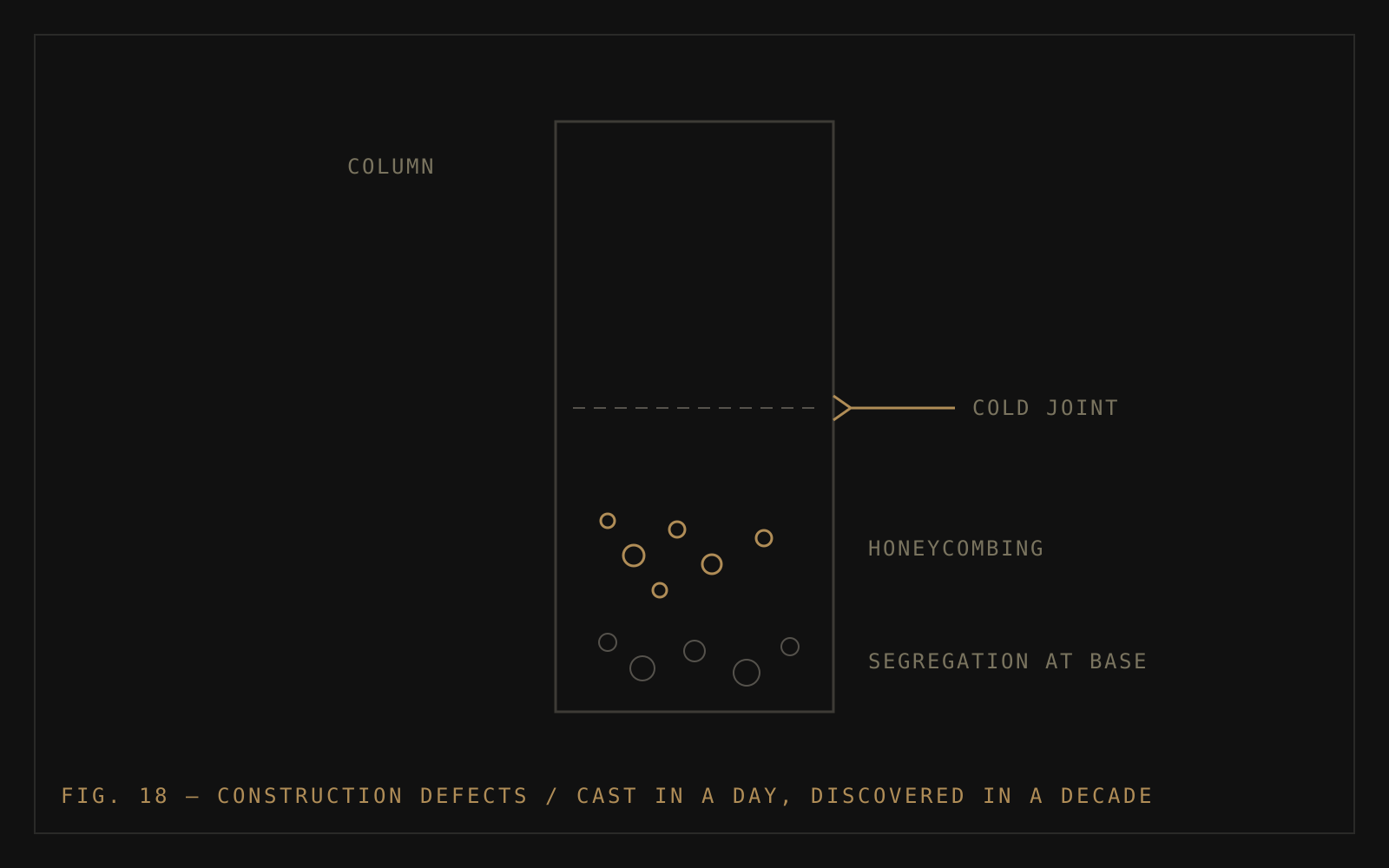
Honeycombing is a zone of interconnected voids in hardened concrete — a texture like its namesake — left where fresh concrete failed to flow around reinforcement or into corners, usually because of inadequate compaction, congested bars, or a mix too stiff for the section. It is a strength defect and a durability defect at once: the voids carry no load, and they are open highways for water and air.
The defect catalogue
| Defect | What went wrong | How it ages |
|---|---|---|
| Honeycombing | Concrete not compacted into corners and around bars | Voids admit water and CO₂ deep into the section; carbonation and corrosion run years ahead of schedule |
| Cold joint | A pour interrupted long enough for the first layer to stiffen before the next arrived | A weak, permeable seam through the member — often the first place water tracks through and leaches |
| Segregation | Coarse aggregate separating from mortar — dropped from height or over-vibrated | Stone-rich zones without cement paste: locally weak, porous, poorly bonded to steel |
| Poor curing | Concrete allowed to dry out in its first days instead of being kept wet | A permanently porous, weak surface zone — exactly the layer that was supposed to be the cover's barrier |
| Displaced reinforcement | Bars pushed off position during casting; spacers missing or crushed | Near-zero cover on one face; rust lines appear along bars years later |
| Contaminated materials | Salty sand or water, unwashed aggregate | Chlorides built into the concrete itself, attacking passivation from day one |
Every entry in that table converges on the same endpoint: water reaching steel sooner than design assumed. Construction defects rarely fail a building outright — they shorten the timeline of the chemistry described in the water and cover chapters.
Why they stay hidden so long
Most of these defects were plastered or painted over within weeks of casting, and none of them affects how a building feels to live in. The structure has ample reserve for daily loads, so nothing creaks or moves. What the defects change is durability, not day-one strength — the carbonation front travels a honeycombed zone many times faster than dense concrete, a cold joint feeds water into the section every monsoon, a displaced bar sits millimetres from the weather behind a coat of paint. The building's twentieth year, not its first, reveals the quality of its construction day.
How an audit finds what construction hid
This is a central reason structural audits test rather than merely look. Ultrasonic pulse velocity is almost purpose-built for construction defects: the pulse slows dramatically through voids and honeycombing, mapping hidden poor-quality zones inside apparently sound members. Cover meter surveys find displaced bars before their rust lines announce them. Rebound hammer screening picks out members whose surface hardness is anomalously low — often the poorly cured or segregated ones. Half-cell mapping shows where corrosion has already begun around built-in defects. And visible clues — leaching lines at old pour levels, patched honeycomb at column bases, rust staining on a young building — tell the trained eye where to aim the instruments.
For a society, the practical lesson is about interpretation: a building with construction defects is not doomed, but its deterioration clock runs fast, and generic assumptions about repair timing do not apply to it. Mapping where the defects are — and treating those zones first — is how a repair budget gets spent where it changes the outcome. It is also why repair supervision obsesses over compaction and curing on repair concrete itself: a badly cast repair patch is simply a new construction defect, and the cycle restarts.